How to check a forex broker’s licence: five registers, walked through
The licence check we run on every review, written out in full: the five registers we use, the three ways a check goes wrong, and what two Seychelles register entries show that their licence numbers do not.
To check whether a forex broker is regulated, find the regulator and licence number the broker publishes, then search for that number on the regulator’s own register rather than trusting the broker’s footer. Confirm three things match: the legal entity name, the permission to deal in derivatives, and the website the register lists.
That last one is where most checks fail. A broker will publish a real licence number belonging to a real company, and the company will be a different company. The number verifies. The broker does not.
This is the procedure we run on every review on this site, written out in full, with the registers we use and a worked example of what an entry shows that the licence number does not.
The three ways a licence check goes wrong
Clone firms. A fraudulent site copies an authorised firm’s name, licence number and sometimes its address, changing only the contact details and the domain. The register entry is genuine. It just belongs to somebody else. This is why the domain on the register matters as much as the number, and why several regulators now publish approved domains alongside each licence.
The wrong permission. A licence is not general approval to do anything financial. It authorises named activities. A firm may hold a real, current licence that lets it advise clients or arrange deals, and not the licence that lets it write contracts for difference as principal. The number checks out. The activity is unauthorised. South Africa is the clearest example and we cover it separately.
The entity and trade-name mismatch. Offshore registers list the licensed company and, where the regulator requires it, the trading names declared against that licence. A brand trading under a licence that does not name it is relying on you reading the number and not the entry. This is the failure mode that is hardest to spot, because nothing on the page is false.
The five registers we use
Financial Conduct Authority, United Kingdom
The Financial Services Register at fca.org.uk/firms/financial-services-register. Search the firm name or the reference number, which brokers publish as an FRN. The entry gives the legal name, status, the permissions the firm holds, its trading names, and the addresses and website the FCA has on record.
Two habits worth keeping. Read the permissions, not just the status, because “Authorised” tells you nothing about what for. And check the FCA’s own warning list in the same session, which names firms operating without authorisation and clone firms of authorised ones.
Cyprus Securities and Exchange Commission
The register at cysec.gov.cy, under regulated entities, covers Cyprus Investment Firms. Search the company name or the licence number, which takes the form of two or three digits, a slash, and a year.
CySEC’s register is the most useful of the five for our purposes because it publishes each firm’s approved domains and the specific investment services it may provide, including whether the firm may deal on own account. A broker whose entity is not authorised to deal on own account, but whose retail clients contract with it as the counterparty, is a real finding you can make from the register alone.
Australian Securities and Investments Commission
The professional registers at asic.gov.au/online-services/search-asic-registers/professional-registers-search. Australian Financial Services licensees are searchable by name or AFS licence number. The entry shows the licence conditions and the authorisations, and ASIC also publishes a list of companies you should not deal with.
Financial Sector Conduct Authority, South Africa
The regulated entities search at fsca.co.za/Regulated-Entities/. This is the register where the permission question bites hardest.
An FSP number is a licence under the Financial Advisory and Intermediary Services Act. It authorises advice and intermediary services. Issuing or writing contracts for difference as principal requires a separate authorisation as an OTC Derivative Provider under the Financial Markets Act, and the ODP list is published separately. A broker leading with an FSP number and no ODP number is quoting a licence that does not cover what it is doing. Three brokers in our database do exactly that.
Financial Services Authority, Seychelles
The regulated entities section at fsaseychelles.sc/regulated-entities, under capital markets, lists licensed securities dealers. The entry gives the licensed company, its company number, the licence number in an SD series, the registered address, contact details, and the trade names declared against the licence.
That trade-name column is the one to read. It is also how we found the following.
A worked example: two pairs of brokers, one licence each
Algobi and HighMarkets are separate brands with separate websites. Both disclose the same legal entity, DXA Seychelles Limited, company number 8438281-1, holding Seychelles FSA licence SD218.
The FSA’s list of licensed securities dealers carries that entity. The trade name recorded against it is ALGOBI, and nothing else. The address is Providence Complex, Office A17 C, and the contact address is an algobi.com one. The entry also lists two websites: www.algobi.com and http://www.highmarkets.com.
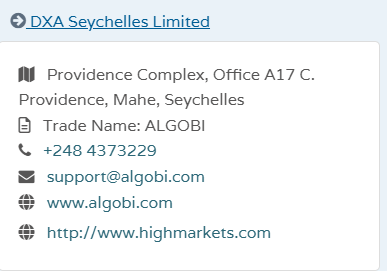
Read closely, that entry says something narrower than it first appears, and the distinction is worth getting right. HighMarkets is disclosed to the regulator, as a website belonging to the licensed entity. What it is not is a declared trade name, which is the field the register uses to record the names a dealer trades under. The honest finding is a gap in one field, not a brand operating on a licence that has never heard of it.
The same page shows what full declaration looks like. Capitalix and FXRoad share one entity, 4 Square SY Limited, on licence SD052, and the entry records Trade Name: CAPITALIX and FXROAD. Two brands, one licence, both named on it.
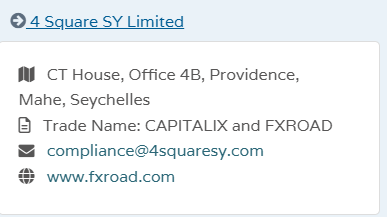
Neither result would have come from reading the licence numbers, and neither would have come from reading somebody else’s summary of them. Both came from opening the entry and reading every field, which is the whole argument for doing this yourself.
The check, in order
- Find the regulator and number on the broker’s own site. Usually the footer or a page called regulation or legal. If no regulator and number appear anywhere, the check is already finished.
- Confirm the body named is the country’s actual financial regulator. Not the licensing body’s own website. If a broker cites an authority you have not heard of, search the national central bank or securities commission of that country and see whether the body has authority to license at all. This is the step that separates a weak licence from a licence that is not one, and it is the subject of our article on MISA licences in the Comoros.
- Search the register by number, then by name. Both, because they can disagree. Note the legal entity exactly as the register spells it.
- Compare four fields. Legal entity name, licence status and date, the permissions or activities authorised, and the website or trade names on record. A mismatch on any one of them is the finding.
- Check the warning lists. The same regulator’s list of unauthorised firms and clones, plus the lists of the regulators in your own country and in the EU. A firm can be genuinely licensed in one jurisdiction and blacklisted in another, which is worth knowing before you deposit.
- Read the entity you would actually contract with. A group can hold a tier-1 licence and route retail clients to an offshore entity through the client agreement. The licence in the footer and the entity on your contract are often not the same, and only the second one matters when you want your money back.
What a licence does not tell you
A current licence from a serious regulator is the strongest single signal available, which is why regulation and fund safety carry 55% of the weight in our scoring. It is still not the whole answer.
It does not tell you what happens if the firm fails. That depends on the compensation scheme behind the licence, and the schemes differ sharply. The UK’s FSCS covers eligible investment claims to £85,000 per person per firm. The Cyprus Investor Compensation Fund pays a maximum of €20,000 per covered client. The Seychelles FSA has no statutory compensation scheme at all, and no statutory leverage cap either, while the FCA, ESMA and ASIC all cap retail CFD leverage at 30:1 on major pairs and 20:1 on non-majors, and the FSC in Mauritius allows up to 100:1.
It does not tell you whether client money is segregated in practice, only whether the rules require it. It does not tell you the firm’s execution quality or its withdrawal record. And it does not stay true. Licences lapse, get restricted, and get revoked, which is why every review on this site carries a last-verified date and why we recheck rather than cite an old check.
You can see which regulator sits behind each broker we have reviewed on our regulator pages.
Frequently asked questions
How do I check if a forex broker is regulated?
Take the regulator name and licence number from the broker’s website, then search that number on the regulator’s own public register. Confirm the legal entity name, the authorised activities and the registered website all match what the broker claims. Do not rely on a regulator logo or a number printed in a footer, since both are trivial to copy.
What is a clone firm?
A fraudulent operation that copies an authorised firm’s name, licence number and sometimes its address, while using its own domain and contact details. The register entry is real but belongs to the legitimate firm. Checking the website and contact details listed on the register, rather than only the number, is what catches it.
My broker’s licence number checks out. Is that enough?
Not on its own. Confirm the licensed entity is the entity named in your client agreement, that the licence authorises dealing in derivatives rather than only advice or intermediation, and that your brand is a declared trading name on the licence. A number can be genuine while the brand using it is not covered by it.
Does an offshore licence mean a broker is a scam?
No. Offshore regulators such as the Seychelles FSA and the Mauritius FSC have genuine statutory authority. What they lack is a compensation scheme and, in Seychelles, a leverage cap. That makes an offshore broker a materially higher risk than a tier-1 one, which is different from a fraud. A licence from a body with no legal authority to license is the separate and more serious case.
How often should I recheck a broker’s licence?
Before you deposit, and again before any large deposit or if the firm changes its terms, its entity or its domain. Licences are suspended and revoked without the broker updating its own website. Our reviews are rechecked on a schedule and each one shows the date it was last verified.
Sources
Financial Conduct Authority, Financial Services Register, fca.org.uk/firms/financial-services-register. Checked 6 September 2026.
Cyprus Securities and Exchange Commission, register of regulated entities, cysec.gov.cy. Checked 6 September 2026.
Australian Securities and Investments Commission, professional registers search, asic.gov.au/online-services/search-asic-registers/professional-registers-search. Checked 6 September 2026.
Financial Sector Conduct Authority, regulated entities search, fsca.co.za/Regulated-Entities/. Checked 6 September 2026.
Financial Services Authority Seychelles, regulated entities, capital markets, fsaseychelles.sc/regulated-entities. Register entries for DXA Seychelles Limited (SD218) and 4 Square SY Limited (SD052) opened and captured at source 6 September 2026.
Compensation and leverage figures verified at source: FSCS £85,000 per eligible person per firm; Cyprus Investor Compensation Fund €20,000 maximum per covered client; FCA, ESMA and ASIC retail CFD leverage 30:1 majors and 20:1 non-majors; FSC Mauritius up to 100:1; FSA Seychelles no statutory cap and no compensation scheme.