Is forex trading legal in India? The rules, and what the RBI Alert List really means
Legal within narrow limits: authorised persons, RBI-authorised platforms or the recognised exchanges, and seven permitted currency pairs. The RBI Alert List is a jurisdiction list, not a fraud list, and six brokers we have reviewed are on it.
Forex trading is legal in India, within limits that are narrower than most traders realise. Residents may transact only with authorised persons, only on RBI-authorised platforms or the recognised stock exchanges, and only in seven permitted currency pairs. Trading through an offshore broker outside that framework exposes the trader, not only the broker, to penal action under FEMA.
That is the legal answer, and it is the one every other page gives. The part those pages leave out is what the RBI’s own Alert List actually means, and why six of the brokers we have reviewed appear on it, including two we rate positively.
What the law permits
The governing statute is the Foreign Exchange Management Act, 1999. The Reserve Bank of India’s position is short and it has not moved:
Resident persons can undertake forex transactions only with authorised persons and for permitted purposes, in terms of the Foreign Exchange Management Act, 1999 (FEMA).
Two conditions there, and both have to hold. The counterparty must be an authorised person, and the purpose must be one FEMA permits. Speculating on currency movements with an offshore CFD broker satisfies neither.
On venue, the RBI is equally specific. Transactions may take place only on electronic trading platforms authorised by the RBI for the purpose, or on the recognised stock exchanges: the National Stock Exchange of India, BSE Ltd and the Metropolitan Stock Exchange of India.
The seven pairs
Exchange-traded currency derivatives on those venues are limited to a defined set, established by A.P. (DIR Series) Circular No. 35 of 10 December 2015:
- INR pairs: USD-INR, EUR-INR, GBP-INR, JPY-INR
- Cross-currency pairs: EUR-USD, GBP-USD, USD-JPY
Seven, and that is the whole legal menu for a retail resident. A broker offering sixty pairs plus gold, indices and crypto to an Indian resident is not operating in a grey area of this framework. It is outside it.
The remittance point that catches people out
Traders often assume the Liberalised Remittance Scheme covers funding an overseas trading account, since the scheme permits residents to remit a substantial annual sum abroad for various purposes. The RBI addresses this directly: remittances for margins to overseas exchanges or overseas counterparties are not permitted under the LRS.
So the deposit itself is the step that breaches the framework, before any trade is placed.
The Alert List, and what it is not
The RBI publishes an Alert List of entities operating outside this framework. The current version is dated 19 November 2025 and names 95 entities. Its own description of itself is the important sentence:
The Alert List contains names of entities which are neither authorised to deal in forex under the Foreign Exchange Management Act, 1999 (FEMA) nor authorised to operate electronic trading platform (ETP) for forex transactions.
Read that carefully, because almost every article that reproduces this list gets the next step wrong. It is a jurisdiction list, not a fraud list. Appearing on it means one thing: the entity does not hold Indian authorisation. It says nothing about whether the firm is honest, whether it is well regulated somewhere else, or whether it holds client money properly.
The list carries its own warning against the opposite error too:
This list is not exhaustive. An entity not appearing in the list should not be assumed to be authorised by the RBI.
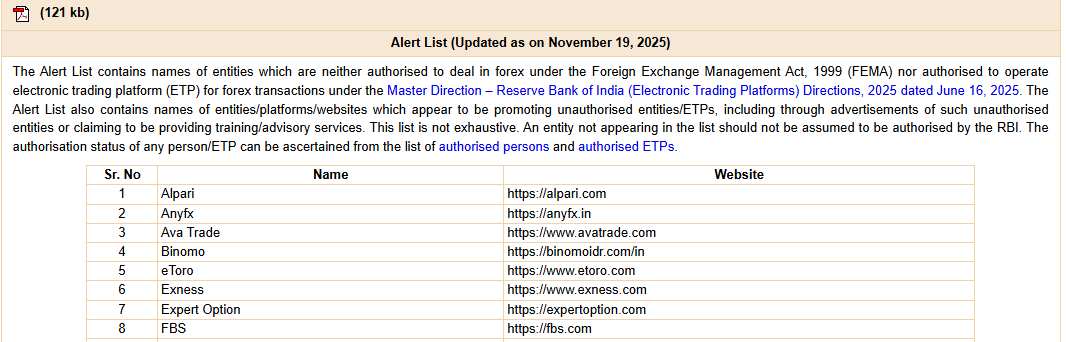
So absence proves nothing, and presence proves something narrower than it looks. Both misreadings are common and both are expensive.
Six brokers we have reviewed are on it
We checked all 95 entries against our own database. The list publishes a website alongside each name, so this is a match on domain rather than on a similar-sounding brand. Six are brokers we have examined and published, and they run the full length of our rating scale.
| Broker | On the RBI Alert List | Our verdict | Why we rated it that way |
|---|---|---|---|
| eToro | Yes | Trusted, 7.5 | Tier-1 regulated, segregated client funds, transparent costs |
| AvaTrade | Yes | Neutral, 6.0 | Legitimate and long established, unremarkable on cost and disclosure |
| Exness | Yes | High Risk, 5.9 | Real licences, but the retail entity most clients contract with is offshore |
| FXRoad | Yes | High Risk, 3.1 | Seychelles licence shared with Capitalix, no compensation scheme |
| NXG Markets | Yes | Scam, 1.8 | A FinCEN money-services registration presented as a trading licence |
| CapPlace | Yes | Scam, 1.7 | MISA licence, Trustpilot rating removed, withdrawals blocked |
We should be plain about the awkward part rather than leave it implied. Two of the six are brokers this site rates positively, and our disclosure page explains that we may hold commercial relationships with brokers we rate Trusted or Neutral. Both things are true at once, and the reason they are both true is the whole point of this article.
eToro at 7.5 and CapPlace at 1.7 sit on the same RBI list for the same reason: neither holds Indian authorisation. On every question about whether your money is safe, they are nothing alike. The Alert List is not measuring that, and it does not claim to.
The practical consequence for an Indian resident, though, is the same for both. Neither is a lawful route, and the protections that make eToro a reasonable choice for a trader in the UK or Australia are not protections Indian law will help you enforce.
Where the penalty actually lands
This is the part most worth internalising. The RBI’s own wording puts the exposure on the resident:
Resident persons undertaking forex transactions for purposes other than those permitted under the FEMA or on ETPs not authorised by the RBI shall render themselves liable for penal action under the FEMA.
Not the broker. The offshore firm is beyond the RBI’s practical reach, which is why the regulator publishes a list of names rather than enforcement actions against them. The person inside the jurisdiction is the trader.
There is a second exposure that has nothing to do with regulators. If an offshore broker refuses a withdrawal, an Indian resident has no domestic recourse, because the transaction was outside the framework that would have provided it. There is no Indian ombudsman for a trade FEMA did not permit. Whatever protection exists is whatever the broker’s own regulator offers a foreign client, which for an offshore licence is usually nothing at all, as the brokers on unrecognised licences demonstrate.
How to trade currencies legally from India
- Use a SEBI-registered broker with access to the recognised exchanges. Currency derivatives are traded on NSE, BSE and MSE, and the broker should be registered with SEBI rather than merely accepting Indian clients.
- Expect the seven pairs. If a platform offers exotic pairs, metals or indices to a resident account, it is not operating inside the exchange framework.
- Do not remit margin abroad. The LRS does not cover it, and the deposit is itself the breach.
- Check the Alert List before depositing anywhere. Then check the broker’s actual regulator separately, because the list tells you about Indian authorisation and nothing else.
- Take tax and legal advice for your own circumstances. This article sets out the regulatory position as published. It is general information, not legal or tax advice, and FEMA matters turn on facts we cannot see.
Frequently asked questions
Is forex trading legal in India?
Yes, within limits. Residents may trade currency derivatives through authorised persons on RBI-authorised platforms or the recognised stock exchanges (NSE, BSE, MSE), in seven permitted pairs: USD-INR, EUR-INR, GBP-INR, JPY-INR, EUR-USD, GBP-USD and USD-JPY. Trading with offshore brokers outside that framework is not permitted and exposes the trader to penal action under FEMA.
What is the RBI Alert List?
A list published by the Reserve Bank of India naming entities that are neither authorised to deal in forex under FEMA nor authorised to operate an electronic trading platform for forex transactions. The version dated 19 November 2025 names 95 entities. The RBI states the list is not exhaustive, so an entity’s absence does not mean it is authorised.
Does being on the RBI Alert List mean a broker is a scam?
No. It means the entity holds no Indian authorisation. The list includes both outright frauds and large brokers with genuine tier-1 licences elsewhere that simply have not sought Indian authorisation. Six brokers we have reviewed appear on it, with our own verdicts ranging from Trusted to Scam. For an Indian resident the legal position is the same either way; the safety of the money is not.
Can I use the LRS to fund an overseas forex account?
No. The RBI states that remittances for margins to overseas exchanges or overseas counterparties are not permitted under the Liberalised Remittance Scheme. The deposit itself falls outside the framework, before any trade is placed.
Who gets penalised, the trader or the broker?
The RBI’s wording places the exposure on the resident: a person transacting for purposes other than those permitted, or on platforms the RBI has not authorised, renders themselves liable for penal action under FEMA. Offshore brokers are largely beyond the regulator’s practical reach, which is why the RBI publishes names rather than enforcement actions against them.
Which currency pairs can Indian residents legally trade?
Four INR pairs, USD-INR, EUR-INR, GBP-INR and JPY-INR, plus three cross-currency pairs, EUR-USD, GBP-USD and USD-JPY, on recognised stock exchanges. This was set out in A.P. (DIR Series) Circular No. 35 of 10 December 2015.
Sources
Reserve Bank of India, press release clarifying that resident persons may undertake forex transactions only with authorised persons and for permitted purposes, only on RBI-authorised ETPs or the recognised stock exchanges, that LRS remittances for margin are not permitted, and that residents transacting outside the framework render themselves liable to penal action under FEMA. Checked 12 September 2026.
Reserve Bank of India, Alert List, updated as on 19 November 2025, 95 entities, published at rbi.org.in, including its statements of scope and of non-exhaustiveness. Checked 12 September 2026.
Reserve Bank of India, A.P. (DIR Series) Circular No. 35, Guidelines on trading of Currency Futures and Exchange Traded Currency Options in Recognized Stock Exchanges, 10 December 2015, for the permitted currency pairs. Checked 12 September 2026.
The Alert List publishes a website against each entity, so the six matches above were confirmed by domain and not by name alone: avatrade.com, etoro.com, exness.com, fxroad.com, capplace.com and nxgmarkets.com, each matching the website recorded on the review linked in the table.
Verdicts and scores from the six-pillar method published at our methodology. Commercial relationships are set out at our disclosure page.