What a MISA licence actually is, and why the Comoros central bank calls it illegal
Seven brokers in our database hold a licence from the Mwali International Services Authority. On 10 December 2025 the Comoros central bank named MISA among fictitious structures issuing approvals without authority, and referred them to three prosecutors.
A MISA licence is a permit issued by the Mwali International Services Authority, a body operating from the island of Mohéli in the Comoros. On 10 December 2025 the Banque Centrale des Comores named MISA among fictitious structures issuing licences without authority, said that licensing financial institutions is its exclusive remit, and confirmed it had already referred these bodies to prosecutors.
Seven brokers in our database hold one. Every one of them presents it the way a broker presents an FCA or CySEC number: a regulator name, a licence number, a registered address, printed in the footer as evidence that somebody official is watching. Nobody is.
This article sets out what the licence is, what the Comoros central bank actually said, and what the distinction means for a trader who has already deposited.
What MISA claims to be
The Mwali International Services Authority presents itself as the financial services regulator for the autonomous island of Mohéli, one of the three islands of the Union of the Comoros. It issues what it calls international brokerage licences, banking licences, and company registrations. The brokerage permits carry reference numbers in a BFX series, and they are cheap and quick to obtain relative to any tier-1 jurisdiction.
What MISA does not claim, anywhere, is that it supervises the firms it licenses in the way a financial regulator does. There is no published capital requirement you can check, no client-money rulebook, no conduct handbook, no complaints process with an outcome you could enforce, no compensation scheme, and no enforcement register listing actions taken against licensees. A licence is issued. Nothing follows it.
That alone would make it a weak licence. The central bank’s position makes it something else.
What the Comoros central bank said on 10 December 2025
On 10 December 2025 the Banque Centrale des Comores published a communiqué on the illegal exercise of offshore banking activities, carried on the website of the Comorian Ministry of Finance, Budget and the Banking Sector.
It opens by warning the public against institutions claiming to be licensed by competent Comorian authorities for offshore banking:
La Banque Centrale des Comores met en garde le public contre plusieurs banques qui prétendent être agréées par des autorités compétentes comoriennes pour l’exercice d’activités bancaires offshores.
It then names what it calls fictitious structures purporting to issue approvals, and lists the entities said to be licensed by each. Among those structures is the Mwali International Services Authority, listed alongside eight entities described as being licensed by it, including Wealth Bank Ltd, GSB Gold Standard Bank Ltd and Forbes Private Bank. A second group is listed against bodies described as so-called Anjouan authorities.
On its own jurisdiction the bank is direct. Licensing of banks and financial establishments operating in the Comoros, it states, falls within its exclusive remit:
l’agrément des banques et établissements financiers exerçant aux Comores est de son ressort exclusif
And it records that the matter is already with the courts:
La Banque Centrale des Comores a d’ailleurs déjà saisi les parquets de Moroni, Mutsamudu et Mohéli contre ces prétendues autorités et ces entités offshores.
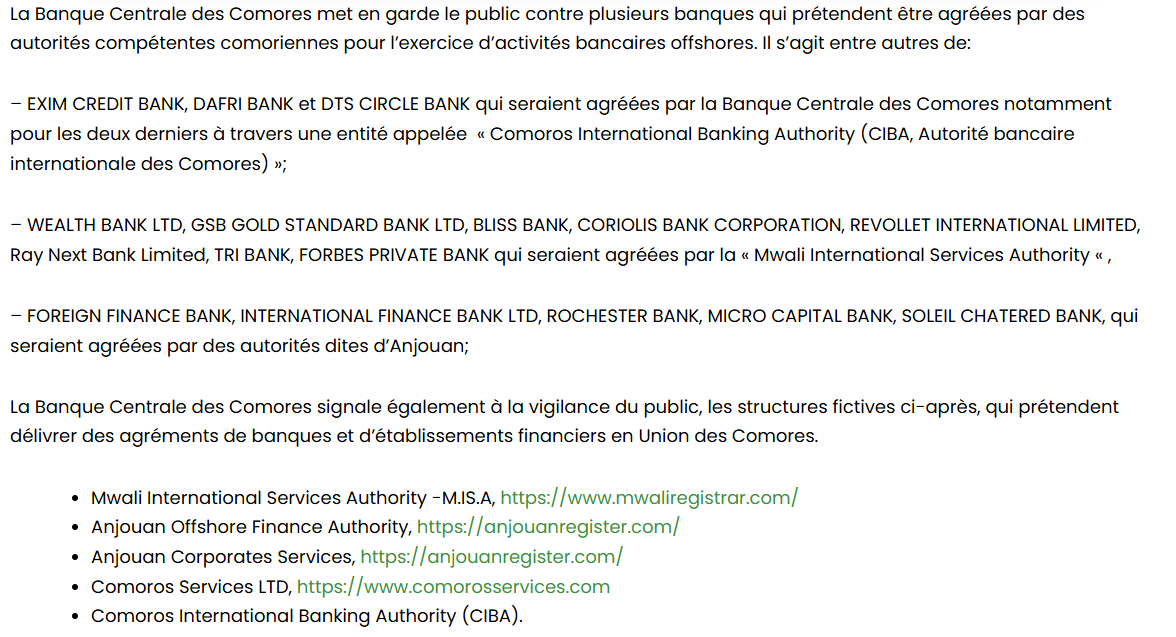
Three prosecutors, in three jurisdictions, against the bodies issuing the licences and against the entities holding them.
Two things the communiqué does not say
Precision matters here, because the gap is where a broker’s defence would sit.
First, the communiqué addresses offshore banking. The entities it names are banks. No forex or CFD broker is named in it, and none of the seven brokers in our database appears on the list. What the document establishes is the status of the body that issued their licences, not a finding against any of them individually.
Second, the December 2025 publication is not the first time the central bank has said this. Trade coverage of the communiqué reports that it restates a warning the bank first issued in June 2022. The position is settled and long-standing rather than a recent development a broker could claim not to have known about.
Neither point weakens the conclusion. The central bank’s statement of exclusive competence is not limited to banks. It covers banks and financial establishments, and it is a statement about who may license, not about who has been caught.
Why the authority question matters more than the paperwork
The usual way to describe an offshore licence is on a scale. Tier-1 regulators such as the FCA and CySEC sit at one end with capital rules, client-money segregation, leverage caps and a compensation scheme. Offshore regulators such as the FSA in Seychelles or the FSC in Mauritius sit lower down, with real statutory authority but thinner protections and no compensation fund. On that scale, MISA looks like a further step down.
It is not on the scale at all. A licence from a body without the legal authority to license is not a weak permission. It is not a permission.
The practical difference shows up the moment something goes wrong. With a Seychelles FSA licence, a trader whose withdrawal is refused has a supervisor to complain to, an entity on a public register, and a regulator that can suspend or revoke. The outcome may be poor and there is no compensation scheme behind it, but the mechanism exists. With a MISA licence there is no supervisor with standing, because the issuing body is one the national central bank has referred to prosecutors. The complaint has nowhere to go.
A law firm analysis published in November 2025 by Manimama reaches the same conclusion from the statutory side, reading Comorian banking law 13-003/AU of 12 June 2013 as reserving banking and financial operations to entities licensed by the central bank, and concluding that a MISA certificate creates no lawful right to carry on brokerage within the Union. We cite that as a lawyer’s reading rather than as a court’s finding, because no court has yet ruled.
The brokers in our database holding a MISA licence
All seven are published, and every one of them gives the same registered address.
| Broker | Legal entity | MISA licence | Our score |
|---|---|---|---|
| Airmarkets | Airmarkets Comoros Ltd | BFX2026046 | 2.3 |
| FirstECN | Nakito SA | BFX2024050 | 2.1 |
| BXB Markets | Dynamix Ltd | BFX2025065 | 2.1 |
| Axwel | Flux Ltd | BFX2025069 | 2.1 |
| NXG Markets | NXG Markets Limited | Registered at the same address; leads with a FinCEN MSB number and FSCA 51192 rather than a MISA number | 1.8 |
| CapPlace | Robertson Finance Inc. | T2023294 | 1.7 |
| TradGrip | Zenith Markets PLC | BFX2024031 | 1.7 |
The licence numbers are sequential across years, which tells you the series is a simple issuance counter rather than anything derived from the firm.
None of these brokers is scored badly because of the MISA licence alone. Each carries its own findings, and you can read them individually. But the regulation and fund safety pillars together carry 55% of the weight in our scoring method, and a licence from a body with no authority to issue one scores at the floor on both.
One address in Fomboni
Seven brands in our research give a registered address on Bonovo Road, Fomboni, on Mohéli. They also share a Silver, Gold and Platinum account tier structure, the same set of payment provider logos, and restricted-jurisdiction wording that is close to identical from site to site.
We record that as an observation and stop there. A shared address in an offshore company formation jurisdiction is normal, because the licensing agent’s office is the registered office for everything it forms. It is evidence of a common service provider. It is not evidence of common ownership, and we do not assert any.
We tested one hypothesis that would have gone further. The sites serve assets from WordPress multisite upload paths with differing site IDs, which would point at a single network if they were sub-sites of one installation. Requesting one brand’s upload path on another brand’s domain returns a 404, so they are not sharing a filesystem. Every domain also sits behind Cloudflare, so DNS reveals nothing about the origin. The hypothesis failed and nothing in any of our reviews claims shared infrastructure.
What to do if you already have money with one of these brokers
Nothing in this article is a prediction that a particular firm will refuse a withdrawal. It is a statement about what happens if one does.
- Request a withdrawal now rather than later, and keep the record. Screenshots of the request, the account balance and every reply. If a dispute follows, the evidence you have on the day is the evidence you will have.
- Expect no regulatory recourse. There is no supervisor with authority over the licence, no ombudsman, and no compensation scheme. Complaints to MISA go to the body that is itself the subject of a prosecutor referral.
- Card payments may still have a route. A chargeback runs through your card scheme and your bank, not through the broker’s regulator, so it does not depend on the licence being real. Time limits are short and vary by scheme.
- Report it in your own country. Your national regulator can add the firm to a warning list even where it cannot act against it, which is what makes the next person’s search return something useful.
- Treat a bonus, a tax demand or a fee as a condition of release as a warning sign in itself. A regulated broker cannot make your own money conditional on a further payment.
If you are still choosing a broker, the more useful exercise is the one that would have caught this before the deposit: checking the licence on the regulator's own register rather than on the broker’s own footer.
Frequently asked questions
Is a MISA licence legal?
The Banque Centrale des Comores stated on 10 December 2025 that licensing banks and financial establishments in the Comoros is its exclusive remit, named MISA among structures purporting to issue approvals without that authority, and confirmed it had referred those bodies to the prosecutors of Moroni, Mutsamudu and Mohéli. No court has ruled. On the central bank’s stated position, a MISA licence is not a valid financial licence.
Is MISA the same as the Anjouan regulator?
They are separate bodies on separate islands, Mohéli and Anjouan, but the same communiqué addresses both. It lists entities said to be licensed by so-called Anjouan authorities in the same document and refers both groups to prosecutors. An Anjouan licence raises the same authority question as a MISA one.
Does a MISA licence give me any compensation if the broker fails?
No. There is no compensation scheme attached to a MISA licence. For comparison, the UK’s FSCS covers eligible investment claims to £85,000 per person per firm and the Cyprus Investor Compensation Fund pays a maximum of €20,000 per covered client. Offshore regimes such as the Seychelles FSA have no scheme either, but they at least have a supervisor.
My broker shows a MISA licence and a UK or Cyprus company number. Does that help?
Not by itself. A company registration is not a financial licence. A UK company incorporated under SIC 70100, activities of head offices, has no FCA permission, no capital requirement and no client-money obligation. A Cyprus company number is not a CySEC licence. Check the financial regulator’s register, not the company register.
How do I check whether my broker’s regulator is real?
Search the national central bank or financial regulator of the country named, not the licensing body’s own website. In the Comoros the relevant authority is the Banque Centrale des Comores. If the body issuing the licence is not the body the country’s law puts in charge of licensing, the licence does not do what it appears to do.
Sources
Banque Centrale des Comores, Communiqué de la Banque Centrale des Comores sur l’exercice illégal d’activités bancaires offshores, published on the site of the Ministère des Finances, du Budget et du Secteur Bancaire, 10 December 2025. Checked 6 September 2026.
Finance Magnates, Is The End of The Comoros “License” Mirage Coming?, 19 March 2026, for the report that the December 2025 communiqué restates a warning first issued in June 2022. Checked 6 September 2026.
Manimama, Legal status and regulatory validity of the MISA brokerage licence, 18 November 2025, cited as a law firm’s statutory reading of Comorian banking law 13-003/AU of 12 June 2013. Checked 6 September 2026.
Legal entity names, licence numbers and registered addresses taken from each broker’s own website and recorded in the individual reviews linked above. Checked 6 September 2026.