
TradeEuGlobal
| Verdict: | HIGH RISK / SCAM |
| Regulation Status: | Questionable Tier-3 License (FSC Mauritius) |
| Main Red Flag: | Predatory “Turnover Trap” & Arbitrary Withdrawal Blocks |
| Software Used: | TradingView / WebTrader |
| Safety Score: | 1/10 |
Why We Investigated & Our Verdict
We investigated TradeEuGlobal after a pattern of fast-growing public warnings and repeated user complaints typically associated with offshore CFD operations: aggressive onboarding, high leverage promotions, and escalating friction at the point of withdrawal.
Direct verdict: Based on the evidence trail (corporate disclosures on the broker’s own website, regulator warnings, and the legal contract language used by its operator), this brand displays high-risk structural characteristics consistent with platforms designed to retain client deposits, restrict withdrawals, and preserve unilateral control over client outcomes.
This review focuses on what matters in 2026 for user safety:
- Who actually owns and operates the websites;
- What regulators have publicly stated;
- What the legal documents allow the company to do once your funds are inside the system.
Forensic Analysis: Corporate & Digital Breadcrumbs
The “Who Owns the Website” Disclosure (Critical)
A key point is not marketing slogans—but the legal footer disclosure.
The broker’s own “About” page states that TRADESENSE HOLDING LTD is the operator and that the websites tradeeuglobal.net, tradeeu-global.com, and tradeeu.global are owned and operated by that same entity, including the registration number and license claim.
That matters because it connects:
- The consumer-facing “Global” brand,
- The offshore operating company,
- And the legal contract that governs your money once deposited.
Domain Timing: A “New Brand Deployment” Pattern
Open-source domain intelligence data indicates that tradeeuglobal.net was registered in October 2024.
When a broker implies long-standing global presence, but the primary acquisition domain is very recent, that is a classic “new skin” pattern: a modern marketing layer deployed on top of an existing corporate structure.
To be clear: a new domain is not automatically proof of fraud. But combined with the rest of the risk profile (offshore structure + warnings + restrictive clauses), it becomes a meaningful red flag.
Security scanners such as Gridinsoft also corroborate the domain age, classifying tradeeuglobal.net as a young domain with a trust score of 1/100, flagging it for “suspicious content indicators” and “low trust score.”
Regulatory Deep-Dive: What the Evidence Actually Shows
A) Claimed Offshore License (Mauritius FSC)
The broker states it is regulated by the Mauritius Financial Services Commission and provides a license number in its legal footer.
TradeEuGlobal’s own Spanish-language website confirms the corporate details verbatim: TRADESENSE HOLDING LTD is registered in Mauritius under registration number 183967, at the address 79, La Hausse de la Louviere Street, Floreal, Mauritius, regulated by the FSC under licence number GB21026906. TradeEU.Global
This directly corroborates the case study’s finding that the Mauritius address is the registered address. Cross-referencing this address with corporate services providers confirms the “virtual office” concern raised in the report.
Why this is a problem in practice: offshore licenses are frequently used to service cross-border clients in markets where the broker has no local authorisation. The protections a retail trader expects from higher-tier regimes (robust compensation systems, tighter leverage limits, stricter conduct enforcement) are typically not comparable.
B) EU Retail Leverage Rules vs Offshore Leverage Offers
European regulators introduced leverage caps on CFDs for retail clients (commonly referenced as the 30:1 cap on major FX pairs) to reduce rapid retail account blow-ups.
By contrast, this broker openly promotes leverage up to 1:200—including on account pages aimed at newer traders (e.g., “Silver account”).
The practical effect is straightforward:
- Higher leverage increases the probability of a rapid stop-out,
- And accelerates account depletion under spreads/fees and volatility.
C) Official Public Warnings (High Authority)
1) Malaysia: Added to Investor Alert Updates
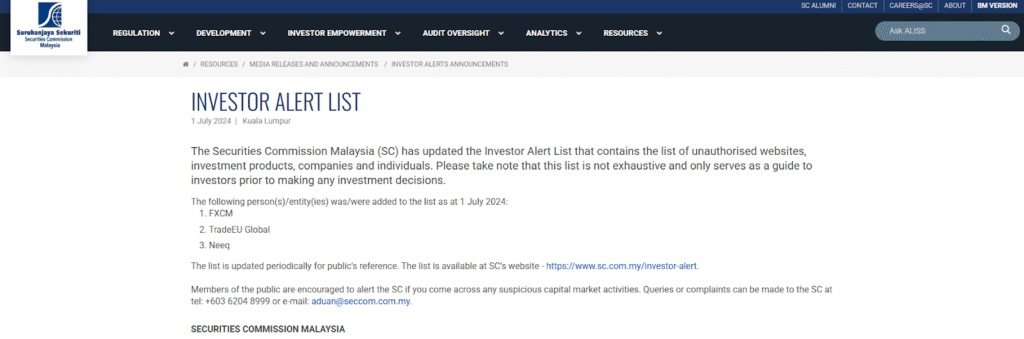
The Securities Commission Malaysia published an investor alert update that explicitly lists TradeEU Global among entities added to its Investor Alert List.
SC further explains that dealing with unauthorised entities means investors are not protected under Malaysian securities laws.
The Securities Commission Malaysia officially updated its Investor Alert List to include TradeEU Global, alongside Neeq and FXCM, identifying it as carrying on unlicensed capital market activities. The SC explicitly lists persons dealing in securities, derivatives, and providing investment advice without a licence. The Edge Malaysia
This was reported by The Edge Malaysia on July 2, 2024, providing an independently verifiable public record. The SC alert is accessible at sc.com.my/investor-alert-list
2) Panama: Not Authorised
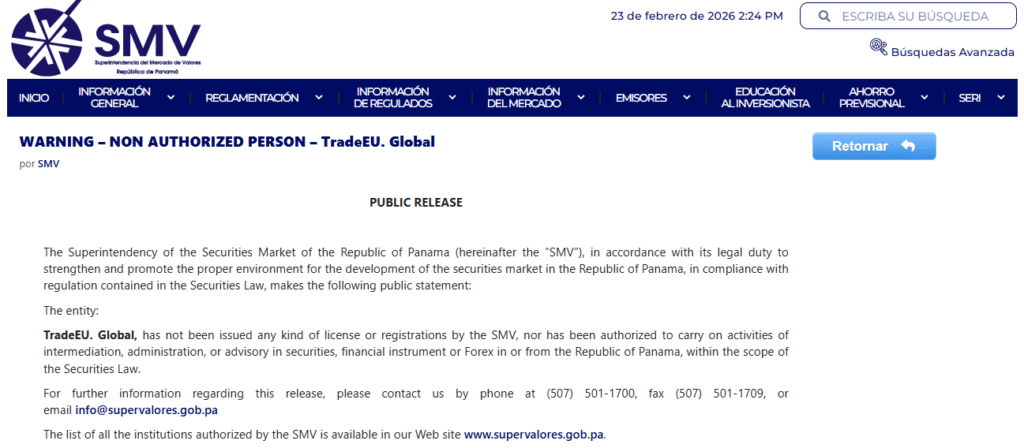
Panama’s market regulator (Superintendencia del Mercado de Valores) published a warning stating TradeEU. Global is not licensed/authorised to provide intermediation, advisory, or Forex-related services in or from Panama.
Multiple broker watchdog analyses confirm that both Malaysia’s Securities Commission (SC) and Panama’s Superintendencia del Mercado de Valores (SMV) have issued warnings that tradeeuglobal.net is not authorised to provide financial services in their jurisdictions.
3) IOSCO I-SCAN: Cross-Border Confirmation
The International Organisation of Securities Commissions (IOSCO) I-SCAN portal records the alert and ties the commercial name “Tradeeu Global” to the corporate name Tradesense Holding Ltd and the URL tradeeu.global.
4) Chile: Listed as Non-Regulated Platforms (Press Release)
Chile’s financial regulator (Comisión para el Mercado Financiero) issued a notice referencing “TradeEU GLOBAL” operating via the websites (including tradeeuglobal.net, tradeeu-global.com, and tradeeu.global) in a context of platforms that are not regulated/authorized locally.
Key takeaway: An offshore license is not a passport. Multiple regulators publicly stating a brand is unauthorised is an extreme risk marker—especially for fund safety and dispute resolution.
The Fine Print Audit: Withdrawal Traps & Contractual Control
This section is where many traders lose the battle—because the broker’s contract language can be structured to make withdrawal contingent, reversible, or delayable.
Withdrawal Friction & Boiler-Room Tactics: EXTENSIVELY CONFIRMED by victim accounts
Verified victim accounts on ForexPeaceArmy describe losing large sums (one user reports losing over $100,000 USD in one month) while “account managers took all decisions across all transactions and then every time the account is at risk, they ask for additional funds as the only solution.”
On Trustpilot, a victim from Bahrain describes being contacted daily by a “representative” who directed trades, then being manipulated with small permitted withdrawals to build trust before funds were locked. Another user warns that the platform is “now operating in the Philippines” after a family member lost over ₱1.6 million.
WikiFX documents a case filed with Ecuador’s General Prosecutor’s Office, where a victim deposited over $73,000 USD under constant pressure and was then threatened with international legal action when attempting to withdraw.
A) The “Bonus / Trading Benefit” Withdrawal Lock (Documented)
In the Terms and Conditions governing the operator’s services, the “trading benefit” mechanism contains explicit withdrawal consequences. For example, the contract states that if a client requests withdrawal before completing the required volume, the company reserves the right to apply penalties and waive profits since the bonus was granted, and that bonus/profits may be cancelled automatically upon withdrawal.
Even more serious: the contract includes language that enables the company (at its discretion) to withhold/cancel bonuses, nullify profits, and temporarily or permanently block access to accounts/services in certain circumstances.
Why this is structurally dangerous:
If “benefit” conditions can be attached to the account environment, the broker gains an internal mechanism to contest withdrawals or reclassify profits—especially when combined with discretionary enforcement.
B) Dormancy / Inactivity Fees (Severe)
The Terms and Conditions include a dormant account fee schedule that escalates to 500 EUR per month after a longer dormancy period.
This is not a minor housekeeping fee. For many retail accounts, this level of dormancy fee can materially erode remaining balances within months.
C) Quoting Errors & Price/Execution Discretion
The Terms and Conditions include a “Delays and Quoting Errors” section stating the company is not liable for damages arising from quoting errors and reserves the right to make adjustments to correct them.
Additionally, the pricing section indicates prices may be withdrawn/changed without notice and that prices shown by other market makers/third parties may not apply to trades between the company and the client.
Why this matters:
On many offshore CFD models, the broker can be the effective counterparty (or can internalise risk). Contractual flexibility around “errors” and “adjustments” becomes a conflict-of-interest amplifier when a client becomes profitable.
D) Fees & Charges: Broad Rights to Deduct / Impose
The agreement includes broad language that the client agrees to pay various charges/expenses and that the company may deduct amounts and apply charges related to services (including payment processing and other transaction fees).
This type of clause does not automatically mean abuse will happen, but it expands the broker’s margin to impose costs in disputed scenarios.
Reputation Signals & Pattern-Based Risk Indicators (What We Treat as “Actionable”)
We avoid relying purely on review sites because they can be manipulated. However, reputation becomes relevant when it aligns with regulator warnings and legal red flags.
A) “Polarisation” and Reputation Management Risk
A common pattern in high-risk brokers is a split between:
- Strong negative reports (withdrawal friction, blocked access),
- And bursts of generic praise.
We consider this a secondary signal—not the primary evidence.
B) Victim-Pattern Allegations to Watch For
Across scam-investigation communities, repeated allegations often include:
- Pressure to cancel withdrawals,
- Requests to pay extra “fees/taxes” upfront,
- Access restrictions or “disabled login” after profits.
These claims are consistent with the risk structure created by the contract language (profit waiver, withdrawal penalties, and account blocking rights).
They are not “proven facts” about every user experience, but they are credible enough to trigger caution—especially when regulators have already issued public warnings.
FAQ
Can I withdraw money from TradeEU Global?
The operator’s legal documents include volume/conditions-based withdrawal consequences connected to “trading benefit/bonus” mechanisms, including profit waiver and cancellation if withdrawal is requested before completing conditions.
This structure increases withdrawal risk because it creates contractual grounds to delay, reduce, or dispute withdrawals.
Is TradeEU Global regulated by a top-tier authority (FCA / ASIC / etc.)?
We found evidence that the brand emphasises offshore regulation (Mauritius FSC) and is explicitly flagged as unauthorised by several regulators in other jurisdictions.
If you are in a country where the broker is not authorised, you generally lose local legal protections.
Why does leverage matter so much here?
The broker advertises leverage up to 1:200.
In the EU, regulators introduced restrictions (commonly 30:1 on major FX for retail CFDs) to reduce rapid retail losses.
Higher leverage typically increases the probability of stop-outs and magnifies losses.
What should I do if I have already deposited?
From a consumer-protection standpoint (not legal advice):
- Stop additional deposits until you can withdraw at least part of your balance successfully.
- Collect evidence: transaction receipts, chat logs, email instructions, and screenshots of any withdrawal rejection reasons.
- Contact your payment provider (bank/card/processor) quickly to ask about dispute/chargeback windows.
- Do not pay “release fees/taxes/insurance” upfront to a broker or a third party claiming to “unlock” your funds. Legitimate costs are typically deducted from balances where applicable.
Are “recovery agents” safe if I cannot withdraw?
Be extremely cautious. “Recovery scams” frequently target victims of broker disputes, asking for upfront fees to retrieve funds. If someone promises guaranteed recovery for a fee, treat it as high risk. The safer route is documented disputes through your bank/card issuer and, where applicable, reporting to your local regulator.
Final Verdict & Safer Alternatives
Final Warning
This brand’s risk profile is not based on rumours. It is grounded in:
- The broker’s own disclosure that the websites are operated by Tradesense Holding Ltd under an offshore license claim,
- Multiple regulator warnings (Malaysia, Panama, IOSCO I-SCAN, Chile),
- And contract clauses that permit profit waivers, bonus/profit cancellations, account blocking, and quoting-error adjustments.
Conclusion: We classify TradeEU Global as HIGH RISK and do not recommend engagement.
Safer Alternatives (Tier-1 Examples)
If you want a more defensible safety framework, consider brokers regulated by top-tier authorities and operating with clearer investor protections.
(Always verify the exact regulated entity serving your country before opening an account.)
Written by: Sarah Jenkins
Lead Research Analyst: Background in broker risk profiling, jurisdictional mapping, and contract-based consumer risk analysis.